


Your Faith Journey with EWTN
As we deepen our relationship with the Eternal Word, Jesus Christ, we grow in grace and are transformed by His love and mercy.
First century–c. 68 A.D.
Patron Saint of accountants, bankers, tax collectors, and civil servants

St. Matthew is one of the most striking examples of conversion in the New Testament. Before becoming an Apostle, he worked as a tax collector in Capernaum, a profession that placed him on the margins of Jewish society. Tax collectors were often viewed with suspicion and resentment because they worked for the Roman authorities and were associated with dishonesty and exploitation.
Yet it is precisely to this man that Jesus extended a personal and life-changing invitation. The Gospel of Matthew records that Jesus saw him sitting at his tax booth and said simply, “Follow me.” In response, he rose and immediately followed Christ, leaving his former life behind without hesitation.
This encounter reveals one of the central themes of the Gospel: the power of mercy and divine calling. Matthew’s transformation is not presented as gradual reform but as a decisive response to the presence of Jesus. He then invites Jesus to his home, where many tax collectors and sinners gather. Rebuked by Jewish leaders for eating with sinners, Jesus responded, “I came not to call the righteous, but sinners.”
Matthew’s Gospel was placed first in the Bible, and some Church Fathers considered it the first of the four Gospels to be written. His account emphasizes Jesus as the fulfillment of the Law and the Prophets and highlights key teachings, including the Sermon on the Mount and the parables of the Kingdom of God.
According to tradition, Matthew preached the Gospel in Judea and later traveled to take Christ’s message to various regions, including Ethiopia, where some accounts say he was martyred. While accounts of his martyrdom vary, early Christian tradition consistently honors him as a faithful witness who ultimately gave his life for the Faith.
St. Matthew’s life is a powerful reminder that Christ calls disciples by name, regardless of their circumstances, inviting them into a new life with mercy, for mission, and through transformation.
Tax collectors worked on behalf of the Roman authorities, who occupied Israel, which already made them socially and religiously suspect. In addition, many tax collectors were known to collect more than required, keeping the excess for themselves. This combination of political collaboration and perceived dishonesty placed them outside respectable society. That is why Matthew’s calling by Jesus was so surprising: It showed that Christ deliberately reached out to those considered morally and socially excluded.
In Christian art, Matthew is often shown with an angel, symbolizing the divine inspiration of his Gospel. He is sometimes depicted writing his Gospel or holding a book or scroll. Early artistic traditions also emphasize his dramatic conversion, showing him leaving behind money or a tax booth. These images highlight both his former life as a tax collector and his transformation into an Evangelist called to proclaim the Good News.
Matthew is called Levi because the practice of having multiple names was common in first-century Israel, especially among Jewish people working for the Roman government. Scholars and theologians suggest that “Levi” was his Hebrew name, while “Matthew” was his Greek name, much like the Apostle Paul was also known as Saul. As a tax collector living in Galilee, he would have needed his Hebrew name to conduct everyday business with the local Jewish population. Early Church fathers such as John Chrysostom noted that while Mark and Luke referred to him as Levi in their accounts of his call, he openly called himself Matthew in his own Gospel. It may have been a way to contrast his honorable title of “Matthew the Apostle” with his past life as a tax collector, humbly demonstrating and highlighting the redemptive power of Jesus.
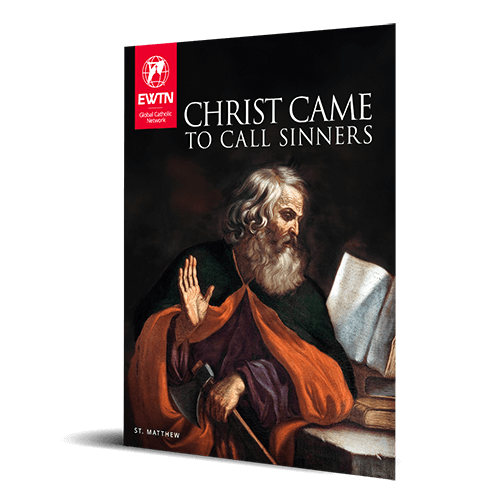
To most people of his day, Matthew would have been considered a “sinner.” Nonetheless, Christ decided to befriend him and showed us that he “came not to call the righteous, but sinners” (Matthew 9:13).
In this eBook, you will learn of how Jesus exemplified His loving mercy to people during His ministry and real-life examples of how other holy men and women followed in his footsteps and did the same.
Get the free eBook below:
Be inspired to follow in the footsteps of the saints. Subscribe to receive the Daily Saint, featuring a brief biography delivered to your inbox each day.
Start now and let the intercession and witness of the saints draw you closer to God.

As we deepen our relationship with the Eternal Word, Jesus Christ, we grow in grace and are transformed by His love and mercy.
STEP 1
We’re here to serve you. Let us help you complete your gift with confidence.

Send a message to Mission Advancement.

Guidance for DAFs, stock, IRA, and more.

Manage your gifts and preferences.


